
Introducing Couturier Ann Lowe: A Floral Enthusiast's Delight
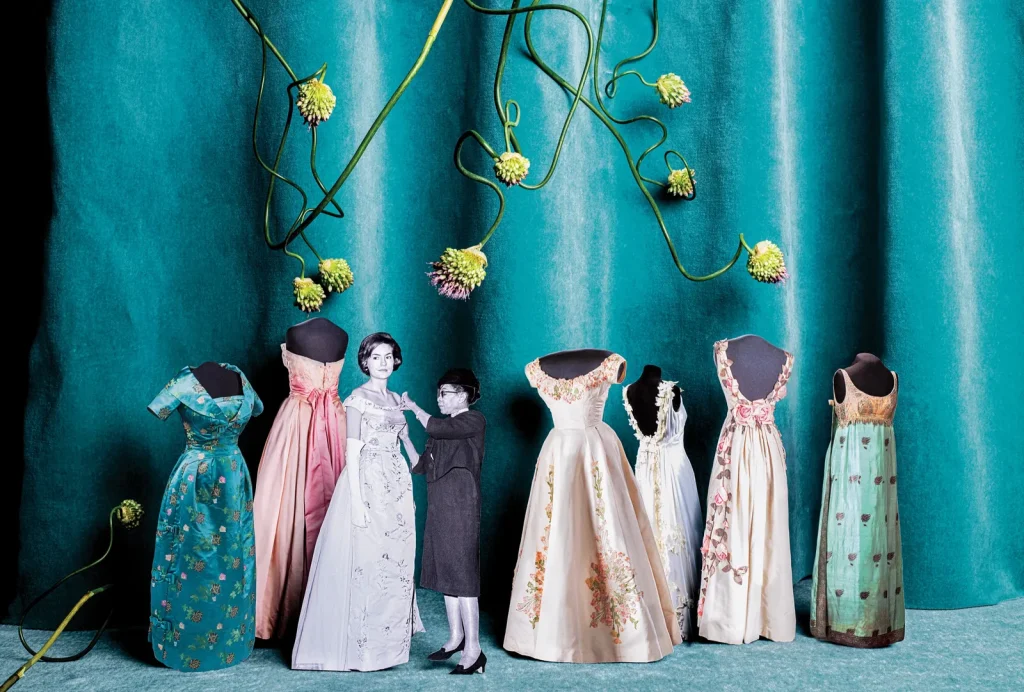
As a gardener, my heart belongs solely to flowers. Vegetables? They don’t captivate me. Shrubs? Not my cup of tea. All I crave is a garden filled with vibrant blossoms. I dream of overflowing bouquets of dahlias, a carload of phlox, and fields of golden coreopsis. Seed and bulb catalogs pile up in my living room. And yes, I was front and center at this year’s American Peony Society convention in Syracuse.
While I have no affinity for faux blooms, an exception has been made after discovering Ann Lowe’s creations. A somewhat overlooked American dress designer of her era, Lowe masterfully integrated fabric flowers into her elite gowns for decades. More than mere embellishments, these floral motifs became her signature and played a crucial role in earning her recognition in the world of high fashion.
Over four decades after she passed, 39 of Ann Lowe’s dresses, including a replica of her renowned design – Jackie Bouvier Kennedy’s wedding dress – grace the halls of the Winterthur Museum and Garden, a previous du Pont residence in Delaware, renowned for its year-round blossoming beauty.
During my October visit, I spotted resilient begonias with their distinctively pink stems, radiant around Winterthur’s reflecting pool. Elsewhere, bright strands of goldenrod captured attention. Within the museum, Lowe’s dual-shaded pink American Beauty roses adorned an ivory dress she fashioned for Barbara Baldwin Dowd, a debutante of her time. These roses have retained their allure for over half a century. The sheer spectacle of these dresses, congregated in a single space, left me awestruck. While the curators commend the intricate internal structure of Lowe’s dresses, showcasing features like “wiggle bones,” I found myself irresistibly drawn to the floral motifs.
These American Beauty roses elegantly climb across the shoulders, culminating in two lavish flowers at the waist. Another creation from the 1930s, a silk gown, is awash with red poppies cascading to its hem, meticulously crafted petal by petal. It’s near impossible to envision anything less than enchantment wearing these. As noted by historian Margaret Powell, one gentleman was so charmed by the floral design on his companion’s Lowe dress that he took a flower as a keepsake. The lady later sought Lowe for restoration.
Lowe’s journey into fashion started in her childhood in Alabama. Before the 20th century began, Lowe, with lineage tracing back to an enslaved dressmaker, had fashion in her blood. At a young age, after the sudden death of her seamstress mother in 1914, Lowe stepped up to fulfill an order for Alabama’s governor’s wife. She viewed this as her first major life challenge.
From a tender age, Lowe was immersed in the art, crafting flowers from leftover fabric pieces. Accounts suggest her creations were influenced by garden blooms. One children’s book titled “Only the Best” speculates that a honeysuckle was perhaps her initial muse.
In her younger days, young Ann Lowe might have been surrounded by a plethora of blossoms. The Garden Club of Alabama suggests that her garden might have been adorned with the likes of Alabama croton, prairie false foxglove, lemon beebalm, diamond flowers, and other native plants. By 1916, Lowe relocated to Florida, engaging as a personal seamstress for a citrus-producing family in Tampa. The family estate near Lake Thonotasassa might have been lush with flowering milkweed, and the air likely carried the sweet fragrance of orange blossoms.
These same orange blossoms, which have symbolized love and prosperity for ages, found their way onto Jackie Kennedy’s wedding attire, intricately placed by Lowe on the voluminous A-line skirt. At the Winterthur exhibition, visitors marvel at the exacting replica by Katya Roelse, showcasing the blossoms at the heart of several large rosettes. Constructing these detailed rosettes demanded immense labor, with Roelse and her team dedicating six full days to the task. Regarding Jackie’s feelings about her wedding dress, there is some ambiguity. While some say the dress was the pick of Jackie’s family, others claim Jackie desired something iconic from Lowe. However, Lowe’s determination shone through on the wedding day as she insisted on using the main entrance to deliver the dress, asserting her worth and presence.
Lowe’s unique creative vision is evident in her showcased designs in the “Ann Lowe: American Couturier” exhibition. Yet, her flexibility as a designer is also displayed. A 1941 bride, Jane Tanner Trimingham, desired Bermuda lilies on her gown due to her family’s business connections to the region. Lowe’s brilliance delivered a striking piece, with two pronounced, beaded lilies accentuating Jane’s neckline, making it an unforgettable fashion statement.
Lowe’s affinity for floral designs was part of a legacy stretching back to ancient civilizations. Wealthy Greeks of antiquity adorned themselves with floral accessories. By the Middle Ages, Chinese attire featured floral embroideries. Over time, floral patterns on fabrics gained prominence, with their popularity ebbing and flowing through fashion eras.
Today, the appeal of florals in fashion remains robust. As 2023 is hailed as “the year of floral dresses on the red carpet” by Women’s Wear Daily, iconic brands like Finnish design house Marimekko, renowned for its bold floral prints, have amassed vast online followings. Modern fashion ads, like one for Valentino, flaunt models like Kaia Gerber draped in garments lavishly adorned with floral elements, reiterating the timeless allure of flowers in fashion.
While exploring the Lowe exhibit, I was captivated by her interpretation of the American Beauty roses, poppies, and the enchanting Bermuda lilies. Yet, attempting to identify the rest of her floral designs was a delightful puzzle. An orange dress adorned with delicate blooms evoked images of pansies, but I couldn’t conclude with certainty. Another gown, with its gentle coral-pink tulle flowers, left me pondering its inspiration. Although some of Lowe’s creations resembled actual flowers, they weren’t exact botanical replicas.
However, Lowe’s intent wasn’t to replicate nature’s exactness. Her designs weren’t meant to mirror real flowers; they were fantastical, dreamy interpretations. Lowe catered to the whimsical desires of society ladies envisioning unforgettable evenings, such as the prominent Gasparilla ball in Tampa – an event where a queen was crowned and to which Lowe, despite her contributions, wasn’t welcomed.
Navigating the turbulent waters of establishing a brand and a business as a Black woman in segregated America, Lowe faced immense challenges. Even though she shared a genuine bond with the family that brought her to Tampa, it was heart-wrenching to discover that some affluent clients exploited her. The societal prejudices of the era constantly tested her spirit. But, undeterred, Lowe remained devoted to her passion. She once expressed to the Saturday Evening Post in 1964, “Dresses are my life. If I can’t design dresses, I’d rather just fly off the top of the Empire State Building.”
Though once referred to as a mere “colored dressmaker” by figures like Jackie Kennedy, the Winterthur exhibit corrects historical oversights. After dedicating her life to crafting gowns for others to revel in, Lowe is finally getting her moment in the spotlight, celebrated for her indomitable spirit and unparalleled artistry.