
Kudzu: Reevaluating Its Perceived Harmful Nature?
Ah, the Smithsonian. They have a knack for diving deep and presenting intriguing insights on a multitude of topics. It’s often the case that publications not exclusively focused on gardening tend to bring a fresh perspective and deeper context to plant-related stories, blending in history, culture, and ecology.
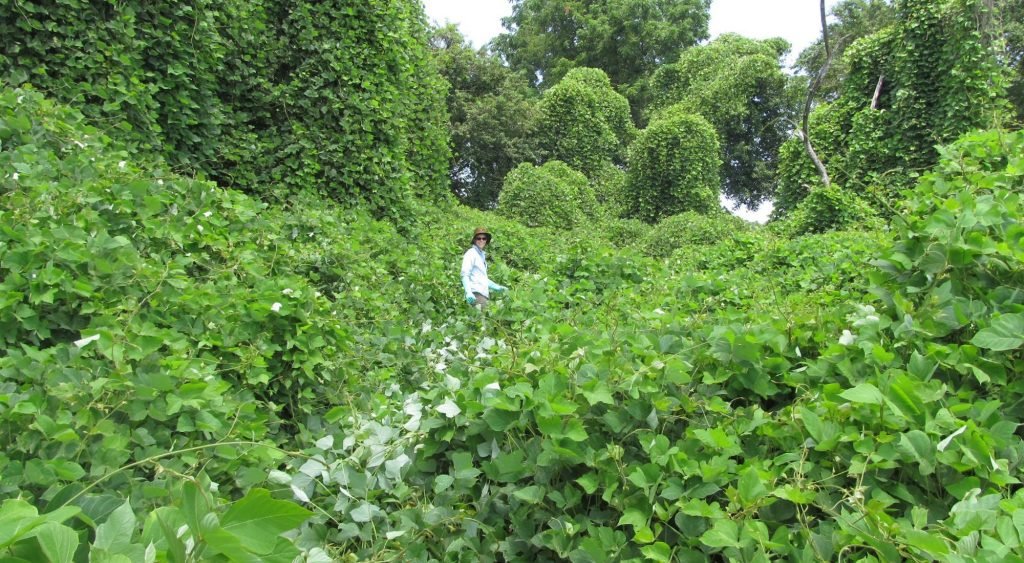
In my experience, kudzu has always been perceived as a relentless vine, overpowering and reshaping vast terrains. While we don’t see it in Western New York, I’ve witnessed its takeover on numerous trips through the South, as it drapes over trees, bushes, and even telephone poles. Sadly, I’ve never been close enough to appreciate its fragrant grape-like blooms or the unique purple honey made by bees that visit it.
Kudzu has always been the poster child for invasive plants. It’s the kind of plant you’d mention to clarify what an invasive species looks like – “Think kudzu.” But Bill Finch, a horticulturist and writer from Mobile, offers a different perspective. In his insightful piece, Finch delves into kudzu’s history, suggesting that its reputation might be a bit exaggerated. He shares an interesting fact: A recent detailed survey by the U.S. Forest Service indicates that kudzu covers around 227,000 acres of forestland, roughly the size of a minor county and about a sixth of Atlanta’s size. This accounts for only about 0.1% of the South’s 200 million acres of forestland. For context, the report estimates that Asian privet has taken over an area 14 times larger than kudzu, and invasive roses have claimed over three times more forest area.
I couldn’t find any barriers to accessing the content, so I won’t delve into further quotes or interpretations. I highly recommend giving the article a read, as it uncovers both myth and fact.
Kudzu has cemented its place in pop culture and even in literary works. For instance, in one of Erica Jong’s novels, the protagonist swims in a water body overrun by kudzu, making her way through it in a contemplative manner. In my region, merely mentioning certain plants on social platforms attracts a barrage of criticisms and warnings, such as buddleia, campsis, wisteria, rose of sharon, to name a few. Notably, these aren’t even flagged by governmental agencies here. Plus, there’s the incessant buzz about “invasive” critters to be wary of. Over time, I’ve learned to tune out much of the noise.
What I appreciate about the piece is its encouragement to understand and appreciate our environment, even if it includes kudzu.
As a side note, a 2021 article from Slate, worth a read, predicts that by 2060, if left unchecked, kudzu wouldn’t even double its present expanse. This challenges the idea of the vine growing at lightning speed. For perspective, Japanese honeysuckle and Asian privet currently sprawl over 10.3 million and 3.2 million acres, respectively.
Additionally, if you’re looking for more on kudzu, the Bitter Southerner has an insightful piece.