
Nasturtiums in Their Natural Habitat
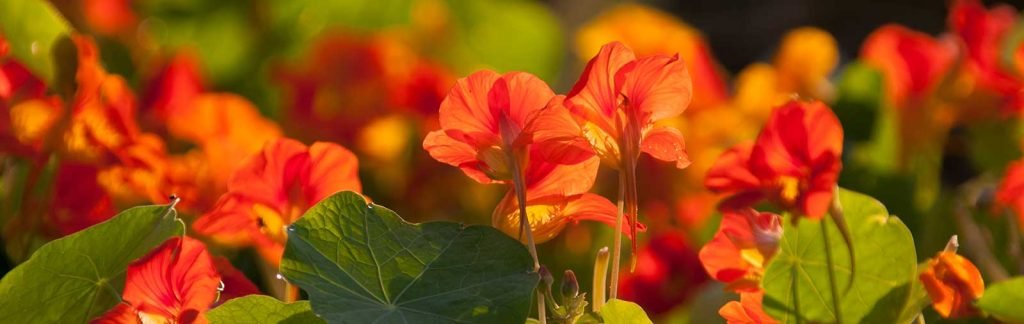
The legacy of gardening often weaves through generations, carrying memories, traditions, and a shared appreciation for the earth and its bounty. For some, it’s roses or tomatoes, but for the Bush lineage, it’s the vibrant, round-leafed, sun-loving nasturtiums.
Molly Bush, the matriarch of the tradition, had an unwavering ritual of planting nasturtium seeds every Good Friday. Despite the looming threat of late frost, Molly’s southern wall in Louisville provided a warm embrace for her beloved nasturtiums. This wasn’t just gardening; it was an act of faith, love, and tradition. Her nasturtiums never faltered, always thriving and blooming with a vigor that resonated with her joyous spirit.
Molly Bush may have been the pillar behind this floral tradition, but her love for nasturtiums was purely aesthetic. In her kitchen, you’d find meatloaf and cherry Jell-O, but not nasturtium salad or pickled seed pods. The idea of consuming them, much less mentioning them in the same breath as Euell Gibbon’s foraging philosophies, never crossed her mind.
Fast forward a generation, and the lore of the nasturtium blooms anew. Molly’s granddaughter, named after her, has embraced the nasturtium not just as a decorative flower but as a culinary gem. Nurtured by the fertile grounds of Bellingham, WA, and the teachings of her mother Ali Mathews, the younger Molly has integrated the plant’s peppery leaves, vivid flowers, and piquant seed pods into her family’s diet. The imagination soars with the thought of a Nasturtium Jell-O or a cake adorned with a medley of colorful blooms.
And it’s not just within the family. The community, too, shares this love. A dinner with the Dalys introduced the wonders of Phoebe Wahl’s baking skills. Wahl, celebrated for her children’s books, also wears the hat of a nasturtium enthusiast, showcasing it beautifully in her “Nasturtium Fairy.”
Yet, the gardening journey isn’t always about successes. For every blooming nasturtium, there’s a story of a Himalayan blue poppy that didn’t flourish or a Lewisia that couldn’t acclimate to unfamiliar terrains. And yes, while the pesky Lewisia’s cousin purslane might frustrate many a gardener, its fresh, lettuce-like taste makes it a delightful wild snack. Gardening is about accepting failures, like rust-ridden hollyhock leaves, while celebrating the miracles, like the lamb’s quarters that sprout unbidden.
Nasturtiums, with their bright, trailing beauty, are indeed almost foolproof. But they’re not just common garden denizens. Their versatility and elegance have found a place even in the esteemed Isabella Stewart Gardner Museum in Boston, renowned for its “iconic Hanging Nasturtiums display.” Such is the allure of this humble plant that bridges generations and traditions.
In the tapestry of gardening, the nasturtium threads in the Bush family weave a story of heritage, discovery, and an ever-evolving love for the earth’s gifts. And as each seed takes root, it carries forth a legacy, ensuring that the tale never ends.
The Circle of Growth: Nasturtiums and Memories
Life often presents us with cyclic patterns, moments that come full circle. The story of the nasturtiums and the white pine stump epitomizes this. A tale that began with an age-old family tradition found its way back through a storm, a loss, and a birthday gift.
The return to one’s roots can be prompted by numerous factors, but for some, it’s a simple gesture – a gift. The decorative tin of nasturtium seeds that Molly sent was more than just a present; it was an invitation back to family traditions, a tether to memories of Good Fridays past. Each seed held the potential of vibrant blooms and the weight of ancestral practices.
Nature, in its unpredictable manner, has its way of altering our plans. The white pine, which had stood tall and proud for half a century, fell victim to the temperamental winds of March. Its majestic form reduced to a mere stump, a testimony to the impermanence of life. Such moments, while heartbreaking, often provide a blank canvas for new beginnings.
Planting the nasturtium seeds around this pine stump wasn’t just about growing flowers; it was about embracing change and finding beauty in new starts. With each germinating seed, the memory of the white pine melded with the growing legacy of the nasturtiums. The initial dry weeks of June may have posed a challenge, but nature has a way of balancing things out. The refreshing rains of July invigorated the plants, leading to a cascade of green leaves and vivid blooms by August.
The image of the nasturtiums embracing the white pine stump paints a poignant picture – one of loss, growth, and rejuvenation. The tumbling stems, with their jellyfish-like leaves, and the spectrum of blossoms, ranging from fiery oranges to mellow yellows, have brought life back to a spot that once signified destruction.
As these flowers bloom and thrive, one can’t help but think of the matriarch who started this tradition. Molly Bush, with her steadfast belief in the power of Good Friday plantings and her love for these ornamental flowers, left behind a legacy that continues to flourish.
The cycle of life, with its ups and downs, joys, and sorrows, is mirrored in the garden. Through storms and calm, dry spells and nurturing rains, the garden grows, reminding us of our own resilience and the beauty of memories. And in this corner of Kentucky, by a once-majestic pine stump, nasturtiums bloom in memory of traditions and loved ones, proving that life, in all its forms, finds a way.